
Care Home & Supported Living · All 33 London Boroughs
Care Home & Supported Living Property Compliance in London
Searching for care home compliance auditing services near London? SR Maintenance manages ongoing premises and statutory compliance across care home and supported-living property portfolios. As one of the top compliance providers for care homes in London, we manage property compliance across your portfolio. Fire, electrical, gas, and statutory premises checks are tracked, scheduled, and recorded in one inspection-ready file. We cover all 33 London boroughs and the M25.
BAFE · NICEIC · Gas Safe · NEBOSH · IFSM · NAPIT · City & Guilds · TrustMark · 12,000+ certificates since 2018 · 4.8 on Trustpilot
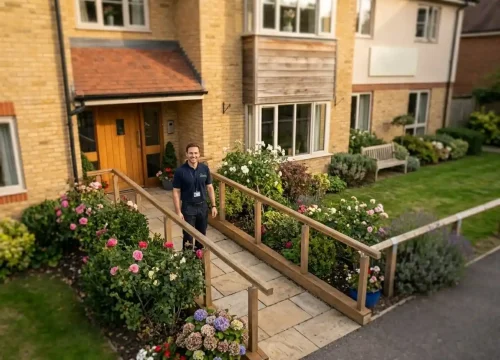
Photo: Compliance engineer inspecting a care-home entrance and access route.
The six premises compliance streams and who delivers each
Care home premises compliance covers 6 key streams, including fire, electrical, gas, water safety and legionella, asbestos, and lifting equipment under LOLER. For supported living compliance London, the same property safety streams need clear records across each scheme. SR delivers 3 in-house, covering fire, electrical, and gas. Specialist contractors handle the other 3, with SR coordinating schedules and recording certificates, dates, and remedial actions.
| Premises stream | Primary legal basis | Delivered by |
|---|---|---|
| Fire safety | Regulatory Reform (Fire Safety) Order 2005 | SR, in house |
| Electrical safety | Electricity at Work Regulations 1989 / BS 7671 | SR, in house |
| Gas safety | Gas Safety (Installation and Use) Regulations 1998 | SR, in house |
| Water safety, legionella | HSWA 1974 / COSHH 2002 / HSE ACoP L8 and HSG274 | Your specialist, SR evidences only |
| Asbestos | Control of Asbestos Regulations 2012 | Your specialist, SR evidences only |
| Lifting equipment, hoists and lifts | Lifting Operations and Lifting Equipment Regulations 1998, LOLER | Your specialist, SR evidences only |
All 6 streams need clear evidence across care and supported living properties. SR keeps the records organised, including certificates and remedial actions from your specialist contractors.
What the law actually requires for care and supported-living premises
Care and supported living premises have defined duties for fire, electrical, gas and in service equipment. Fire risk assessments under RRO 2005 need to be suitable and sufficient. They also need to stay up to date. Full recording has applied since 1 October 2023 under section 156 of the Building Safety Act 2022. For care home compliance with UK regulations in London, electrical safety follows EWR 1989 and BS 7671. The IET recommends a 5-year maximum for fixed wire testing. Gas safety under GSIUR 1998 requires annual checks. PAT follows a risk-based approach under EWR 1989.
| Stream | Primary duty | Frequency reality |
|---|---|---|
| Fire risk assessment | RRO 2005, recorded in full under section 156 BSA 2022 from 1 October 2023 | Suitable and sufficient, kept up to date, no fixed statutory annual cycle |
| Fire detection | BS 5839-1, commonly Category L1 in care homes | Based on fire risk assessment and routine servicing |
| Emergency lighting testing | BS 5266-1 | Periodic testing under the standard |
| Fixed wire / EICR | EWR 1989 / BS 7671 | 5 year IET recommended maximum, shorter where risk supports it |
| Gas | GSIUR 1998 | Annual |
| In service equipment, PAT | EWR 1989 | Risk based |
These requirements cover the main premises safety duties. SR manages fire, electrical, and gas work in-house, with records for inspections, certificates, and remedial actions.
Who legally holds the premises and fire safety duty?
The CQC registration role and the RRO 2005 responsible person are two different legal roles. The responsible person controls the building. This matters for CQC fundamental standards for supported living in London. The care provider and building owner are separate organisations in many supported living settings.
In a care home, the registered provider controls the building. In supported living, the landlord or housing association controls the home and holds the fire safety duty. This creates a clear split between care duties and building duties.
| Role | What it is | Premises and fire duty |
|---|---|---|
| Care home operator | CQC registered provider and building controller | Yes, RRO responsible person |
| Supported living care provider | Provides care | No, where the landlord controls the building |
| Supported living landlord or housing association | Owns or leases the home | Yes, where it controls the building |
| Registered manager | Runs the care service day to day | Not the RRO duty holder |
| Nominated individual | Oversees the care provider | Not the RRO duty holder |
| RRO 2005 responsible person | Person who controls the building | Holds the fire safety duty |
For supported living providers, the landlord holds key fire records. SR helps collect these records from the right people. Certificates, inspection dates and repair actions stay together in one compliance record. This gives the care provider a clear view of property safety across each home.
Evacuation: the fire strategy no one can afford to get wrong
Care homes need a fire plan that works for people who need staff help. Many residents cannot leave on their own. Progressive horizontal evacuation moves residents to a safe area on the same floor. This relies on working fire doors and safe sections within the building.
2025 RPEEP rules: These rules start on 6 April 2026 for certain high-rise residential buildings. A standard care home is not covered. Some supported living homes in high-rise housing association buildings can be covered.
For compliance home care services, the building needs to support the fire plan. SR manages the building records. The care provider manages each resident’s PEEP and care needs.
Sprinklers in new care homes: the 2025 Approved Document B change
From 2 March 2025, amended Approved Document B requires automatic fire suppression and sprinklers in all new care homes, regardless of height. New homes require 10-bed maximum compartments and self-closing bedroom doors. The change is not retrospective for existing care homes. Major refurbishment does not mandate retrofit. SR Maintenance does not design or install sprinklers. For new acquisition or registration, SR Maintenance maps and evidences the premises compliance plan from day one.
How your premises evidence shows up in a CQC inspection
Under the Single Assessment Framework, premises compliance appears mainly through Regulations 12, 15 and 17 of the Health and Social Care Act 2008 (Regulated Activities) Regulations 2014.
CQC can prosecute a breach that causes avoidable harm or exposes a person to a significant risk of harm. A Warning Notice is not required before prosecution.
Premises and equipment must remain clean, secure, suitable, properly used, and properly maintained. CQC cannot directly prosecute a Regulation 15 breach.
Good governance covers records, monitoring, and oversight.
Regulations 12, 13 and 14 carry the prosecution power linked to harm or significant risk. Regulation 15 and much of Regulation 17 do not.
Contracting out premises work does not remove the provider's Regulation 15 responsibility. Evidence needs to show completed work, checks and monitoring.
SR brings premises records, checks, actions and supporting evidence into a structured compliance view. Records need to show what was checked, what was found, what action followed and what evidence supports the position.
Many premises, many clocks the problem no spreadsheet solves
A multi-home operator or supported living provider manages many premises duties on different frequencies. Annual gas checks, risk-based EICR and PAT, plus fire door and detection servicing linked to each FRA, all need clear records. Dispersed schemes across multiple boroughs add landlord coordination. Fragmented contractors and records can break the audit trail and create Reg 17 governance findings. SR maps, schedules, tracks and evidences the full plan in one record.
How we work with care and supported-living providers
Our supported living compliance services in London follow one clear process. SR maps duties, plans work, tracks dates and keeps evidence together.SR Maintenance also works with block management and portfolio properties.
The premises services we deliver in-house
SR delivers premises compliance management for care homes and supported living settings. Each service covers a defined duty, with records linked to the relevant property.
Care home or supported living? Where the rules diverge
Both settings need fire, electrical and gas safety evidence, plus CQC and fire service scrutiny. The main split is premises control. Care homes place building control with the provider. Supported living often places premises duties with the landlord.
Care home means the provider controls the building and care service, creating one main dutyholder. Supported living means the tenant has their own home. The landlord often holds premises duties. CQC regulates care, not the premises. Fire, electrical and gas evidence still needs clear ownership.
Exempt accommodation is not exempt from HMO licensing. It relates to Housing Benefit rules, not property licensing. The Housing Act 2004 still applies where the HMO definition fits, including 5+ occupiers, more than one household and shared facilities.
Care home property compliance London FAQs
New care homes in London fall under the sprinkler requirements introduced on 2 March 2025 through the updated Approved Document B guidance. The requirement applies to new care homes regardless of height.
- Existing care homes do not face an automatic sprinkler installation requirement from this change.
- Building work can create separate requirements.
Free Portfolio Compliance Audit
Book your free portfolio compliance audit
Map every premise, every compliance stream, and every due date. Identify compliance gaps before anything is bought and see where priority action is needed across the portfolio.
Fire, electrical and gas safety delivered in-house
Asbestos, water hygiene and lifts coordinated and evidenced
Care homes and supported living across all 33 London boroughs
We respond within 15 minutes (Mon to Sat). No obligation. SSL secured · ICO Registered.