
Emergency Lighting Testing · All 33 London Boroughs
Emergency Lighting Testing London
Emergency Lighting Testing London helps keep emergency lighting systems compliant with BS 5266-1:2025. Testing of emergency lighting includes regular checks, monthly tests, annual three-hour tests, certification, and logbook updates. Our NICEIC and BAFE accredited engineers provide emergency light servicing across all 33 London boroughs and the M25.
NICEIC · NAPIT · BAFE accredited · 12,000+ certificates since 2018 · 4.8 Trustpilot · all 33 London boroughs + M25
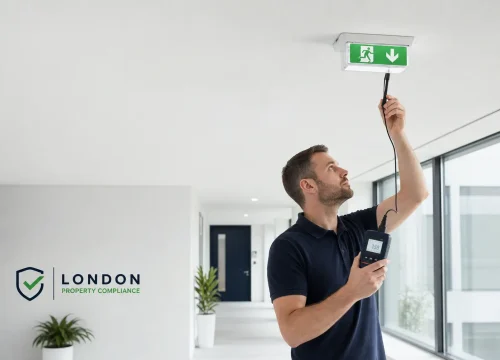
Photo: Engineer testing an emergency exit light
What emergency lighting testing involves
Annual emergency lighting test verifies that emergency luminaires and illuminated exit signs operate correctly during a mains failure. The system switches to battery power and provides suitable illumination in line with BS 5266-1:2025 requirements.
BS 5266 emergency lighting testing includes mains-failure simulation to confirm the system switches correctly during a power failure. The test checks that every luminaire illuminates and exit signs are clean and visible for safe operation. It also includes a full 3-hour duration test, along with battery condition and charging performance checks.
After testing, you receive a Periodic Inspection & Testing Certificate plus completed emergency lighting logbook entries.
An emergency lighting test certificate is not a single universal document. The logbook provides the ongoing record of inspections, test results, and remedial actions.
How often must emergency lighting be tested?
Our emergency lighting compliance services follow scheduled inspections under BS 5266-1:2025 and BS EN 50172:2024. Emergency light compliance testing London follows these intervals to maintain accurate inspection records.
An emergency lighting testing certificate records inspection results with the emergency lighting logbook. Testing includes monthly functional checks, an annual 3-hour discharge test, and five-year photometric verification under BS EN 50172:2024.
What changed in BS 5266-1:2025
BS 5266-1:2025 came into effect on 31 October 2025 and replaced the withdrawn 2016 edition. It is used alongside BS EN 50172:2024 and BS EN 1838:2024. These changes affect emergency lighting testing requirements, verification, scope, and wiring resilience.
Emergency lighting inspection now includes consideration of five-year photometric (LUX) verification under BS EN 50172:2024 Cl. 7.4.5. BS 5266-1:2025 supports this approach.
Emergency lighting checks cover escape lighting, open-area (anti-panic) lighting, high-risk task-area lighting, and standby lighting contexts within the updated scope.
A single fault on a centrally supplied final circuit affects no more than 20 luminaires. Dual-circuit supply applies in high-risk task areas.
BS 5266-1:2025 provides a recognised method for demonstrating compliance with the RRO 2005. The standard itself is not law.
The five-year photometric check is a recommendation of the standard, not a statutory instrument. Source: BS 5266-1:2025, published by BSI.
Is emergency lighting testing a legal requirement?
Yes. Under the RRO 2005 , the Responsible Person must provide emergency lighting under Article 14 and maintain it in efficient working order under Article 17. A competent person can complete testing, but the legal responsibility remains with the Responsible Person.
The legal duty stays with the Responsible Person. A competent provider carries out the testing, certification, and record-keeping. You receive the documents that show your emergency lighting checks are completed.
Who can carry out emergency lighting testing?
Emergency lighting testing is completed by trained in-house staff or competent professionals, depending on the type of test.
Has the skills and experience to test, record results, and identify faults.
SR engineers hold NICEIC/NAPIT and BAFE competence.
Types of emergency lighting we test
Emergency lighting systems vary by operation, power source, and application. We test different luminaire types and coverage categories to confirm the system meets the required design.
Maintained vs non-maintained
Self-contained vs central-battery
How much does emergency lighting testing cost in London?
SR Maintenance tests emergency lighting for the full three-hour discharge and records the results in the test certificate and logbook. The emergency lighting certificate cost depends on the number of luminaires and exit signs, building size, floors, and zones.
We respond within 15 minutes (Mon to Sat). No spam. SSL Secured · ICO Registered.
Emergency lighting testing across a portfolio
Managing multiple buildings means keeping emergency lighting tests, certificates, logbooks, and compliance management organised across every site.
Across your portfolio
Emergency Lighting and Fire Safety Compliance
Emergency lighting is a key part of your Fire Risk Assessment. We provide supporting fire safety services to help maintain compliance, accurate records, and safer premises.
Emergency lighting testing across every London borough
All 33 London boroughs (32 boroughs plus the City of London) and the M25 corridor area for commercial and managed properties.
Emergency Lighting Barking and Dagenham
Emergency Lighting Barnet
Emergency Lighting Bexley
Emergency Lighting Brent
Emergency Lighting Bromley
Emergency Lighting Camden
Emergency Lighting City of London
Emergency Lighting Croydon
Emergency Lighting Ealing
Emergency Lighting Enfield
Emergency Lighting Greenwich
Emergency Lighting Hackney
Emergency Lighting Hammersmith and Fulham
Emergency Lighting Haringey
Emergency Lighting Harrow
Emergency Lighting Havering
Emergency Lighting Hillingdon
Emergency Lighting Hounslow
Emergency Lighting Islington
Emergency Lighting Kensington and Chelsea
Emergency Lighting Kingston upon Thames
Emergency Lighting Lambeth
Emergency Lighting Lewisham
Emergency Lighting Merton
Emergency Lighting Newham
Emergency Lighting Redbridge
Emergency Lighting Richmond upon Thames
Emergency Lighting Southwark
Emergency Lighting Sutton
Emergency Lighting Tower Hamlets
Emergency Lighting Waltham Forest
Emergency Lighting Wandsworth
Emergency Lighting Westminster
Emergency lighting testing London, frequently asked questions
Emergency lighting requires regular checks to confirm it works correctly. The testing schedule includes:
- Daily visual checks for central battery systems.
- Monthly functional tests to confirm operation.
- Annual three-hour discharge tests.
- Five-year photometric (LUX) verification.
The three-hour discharge test checks that emergency lighting batteries maintain illumination for the rated duration. It confirms the system performs during a full emergency period.
- The battery supply is tested through a full discharge cycle.
- Emergency lights are checked throughout the test.
- Results are recorded in the maintenance logbook.
The five-year emergency lighting test is a photometric (LUX) verification. It measures actual light levels and checks them against the emergency lighting design requirements.
- Light levels are measured at required locations.
- Results confirm illumination performance.
- Findings are recorded for compliance records.
Get your emergency lighting testing quote
Complete our quick enquiry form for a quote on emergency lighting testing across HMOs, care homes, and portfolio properties. Share your property details and find the right compliance support for your needs.