
PAT Testing in London: Covering Every Property in Your Portfolio
PAT testing London services help landlords and businesses check plug-in electrical equipment safety across London. Emergency PAT testing services available in London for urgent testing requirements. PAT compliance London is not legally required at fixed intervals. A PAT testing certificate confirms checks under the Electricity at Work Regulations 1989. SR Maintenance’s NICEIC/NAPIT engineers check the right appliances at the right time.
Last updated: September 2026
NICEIC & NAPIT accredited · in-house engineers · 12,000+ certificates since 2018 · 4.8 on Trustpilot · all 33 London boroughs + M25
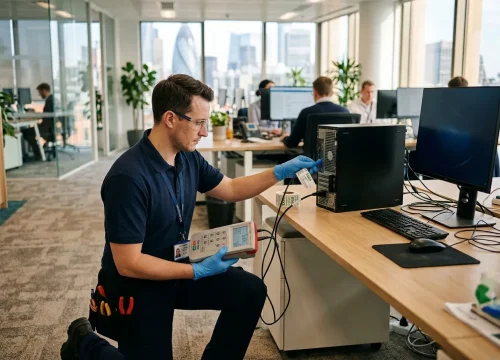
Photo: Engineer testing office electrical equipment for safety
In-house Engineers · Accredited · Insured
Is PAT testing a legal requirement in the UK?
PAT testing is legally required, and every appliance must be PAT tested annually.
No. PAT testing is not a legal requirement in the UK. The term PAT testing legal requirements refers to electrical safety duties, not a fixed testing schedule.
The Electricity at Work Regulations 1989 require electrical equipment to be maintained to prevent danger. Regulation 4(2) focuses on keeping electrical systems safe and does not set a PAT testing schedule.
HSE confirms annual PAT testing is not a legal requirement. Testing frequency depends on equipment type, environment, and risk level, with checks based on the conditions where equipment is used.
PAT testing follows a risk-based approach with user checks, visual inspections, and electrical testing based on each appliance and its use.
How Often Should You PAT Test?
PAT testing frequency depends on equipment type, environment and risk level. PAT testing services in London use user checks, formal visual inspection and combined inspection and testing based on equipment use. Fast PAT testing London supports urgent checks, and landlord PAT testing covers supplied appliances.
What Does PAT Testing Actually Involve?
PAT testing starts with a visual inspection to identify visible faults. Engineers check the plug, cable, fuse and casing before carrying out electrical tests where needed. The appliance class decides the testing method.
Class I uses earth continuity and insulation resistance testing. Class II uses insulation resistance or touch-current testing. SR Maintenance follows BS EN 50699:2020 and BS EN 50678:2020, providing appliance reports and records through our own qualified engineers.
EICR vs PAT Testing: What's The Difference?
EICR checks fixed wiring, sockets and the consumer unit. Portable appliance testing London checks plug-in appliances connected to the electrical supply.
PAT testing for landlords and HMOs in London
For private landlords, there is no statutory PAT testing requirement. However, landlords must ensure supplied appliances remain safe and maintained. Domestic PAT testing provides evidence that household appliances have been inspected and checked.
No legal PAT testing mandate exists for private landlords in England.
Landlords have a duty to keep supplied appliances safe.
PRS 2020 Regulations require EICR checks every five years for fixed installations.
PAT testing HMO services help managers maintain appliance safety records.
PAT testing supports evidence of regular checks in shared properties.
Commercial and workplace PAT testing in London
Commercial PAT testing helps businesses check electrical equipment safety across workplaces. Employers have duties under EWR 1989, HSWA 1974 and PUWER 1998 to maintain work equipment.
SR Maintenance supports mixed workplaces with suitable testing approaches for areas such as kitchens and offices.
How much does PAT testing cost in London?
PAT testing cost in London depends on appliance numbers, site details and testing needs. Pricing includes a visit fee plus per-item charges.
The final cost depends on the number of appliances tested and the site. Each item is tested, fuse-checked and given a new safety tag, with a pass certificate provided after the visit. Right-sizing the regime to risk, rather than blanket annual testing, often costs less over a three-year cycle. London cost factors (congestion, ULEZ, parking) are handled transparently, never a hidden call-out fee.
We respond within 15 minutes (Mon to Sat). No spam. SSL Secured · ICO Registered.
Why choose SR Maintenance for PAT testing
SR Maintenance provides PAT testing through our own qualified PAT tester team, not subcontractors. We support domestic, commercial and HMO properties with reliable testing and clear reports.
How PAT testing with SR works
SR Maintenance keeps PAT testing and compliance management simple, organised, and easy to manage. No contract, no monthly fee.
More Services for Complete Property Compliance
Manage your property compliance services in one place, covering gas safety, fire risk, electrical checks, and fire alarm services.
Gas Safety Certificate
Checks gas appliances and systems for safety issues and provides the required certificate.
Fire Risk Assessment
A clear assessment of fire risks across your property, with practical actions to support fire safety.
Electrical Installation Condition Report
Electrical safety checks that identify faults and provide a clear report on the condition of fixed electrical installations.
Fire Alarm Services
Fire alarm inspection, testing, and servicing to help keep your alarm system in good working order.
PAT testing London, frequently asked questions
PAT testing frequency depends on appliance type, usage and working environment. HSE guidance supports setting suitable intervals based on risk assessment.
- High-risk equipment need more checks.
- Lower-risk items have longer intervals.
- Testing plans consider equipment condition, location and use.
No, landlords do not have a statutory PAT testing requirement in England. They must ensure supplied appliances remain safe.
- EICR covers fixed electrical installations.
- PAT testing provides appliance safety records.
- Appliance checks help landlords maintain evidence of safety duties.
PAT testing provides a report and appliance register after checks are completed. Labels and records are good practice rather than legal requirements.
- Reports show completed appliance checks.
- Records support safety management.
- Documents help track tested equipment and maintenance history.
Book PAT testing across London
SR Maintenance delivers PAT testing London services for landlords, businesses, and property portfolios. Our engineers carry out appliance checks with clear reports and organised records.
NICEIC & NAPIT accredited · in-house engineers · all 33 London boroughs · 12,000+ certificates since 2018