
Fire Risk Assessment · All 33 London Boroughs
Fire Risk Assessment London: Compliance for Property Portfolios
Under the RRO 2005, responsible persons hold fire risk assessments (FRA) duties for workplaces and communal residential areas. Since 1 October 2023, full written records are required for all premises. SR Maintenance manages fire risk assessment London portfolios, carrying out, recording and renewing assessments to BS 9792:2025 and PAS 79-1:2020, with action plans and remediation.
Last updated: September 2026
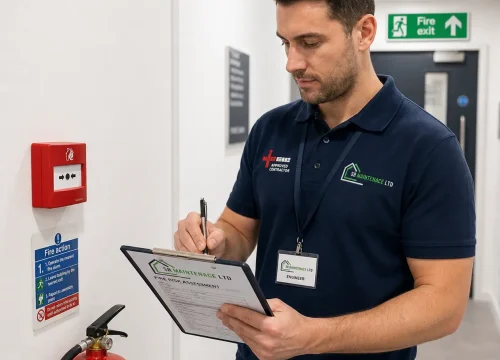
Photo: Fire risk assessor recording safety checks in a corridor
Accredited · Insured · Competent
12,000+ certificates issued since 2018 · Rated 4.8 on Trustpilot
What a Fire Risk Assessment Covers and Who is Responsible
A fire risk assessment fire hazards, people at risk and the precautions needed to reduce fire risks. For properties across London, the Responsible Person holds this duty under the Reform (Fire Safety) Order 2005, including employers, landlords, building owners, and managing agents.
A fire risk assessment in London delivers a clear record of risks, findings and actions required across the premises.
- 1 Identify the fire hazardsA fire risk assessor London identifies fire sources, materials that burn and areas where risks exist.
- 2 Identify people at riskConsider residents, visitors, staff and anyone who needs extra support during evacuation.
- 3 Evaluate and actReduce risks, remove hazards and improve fire safety measures.
- 4 Record, plan and trainKeep a written record, action plan and fire safety information for relevant people.
- 5 Review and updateCheck the assessment when changes affect the building or fire safety risks.
London fire safety law in 2026: what has actually changed
Fire safety laws have changed, and Fire Risk Assessment requirements now focus on accurate assessments and written records. Buildings need clear fire safety information and regular reviews.
How Often is a Fire Risk Assessment Legally Required?
A Fire Risk Assessment must be reviewed every 12 months. This is a legal requirement.
The Regulatory Reform (Fire Safety) Order 2005 requires regular reviews and a review when the assessment is no longer valid. An annual review is good practice, not a legal requirement.
Source: Regulatory Reform (Fire Safety) Order 2005.
The Fire Safety Order 2005 does not set a fixed 12-month review period. A Fire Risk Assessment review is needed after major changes, such as building alterations, change of use, new occupants, or a fire.
Since 2006, review frequency has depended on the building type, fire risk level, and safety arrangements. Fire risk assessment services follow suitable review plans, and fire risk assessments for landlords help track dates across properties.
Types of fire risk assessment: Matching the Right Assessment to the Building
Four recognised fire risk assessment types apply to residential buildings. The right type depends on the building layout, fire risks, and level of inspection needed. Type 1 is suitable for most well-maintained blocks, with higher types used only where there is a clear reason for further checks.
Most purpose-built residential blocks need a Type 1 assessment. A competent assessor uses Type 2 or Type 4 only where there is a specific reason linked to hidden fire safety risks. Building age alone does not decide the assessment type.
How we manage fire risk assessments across your portfolio
As experienced fire risk assessment providers in London, we organise each stage from the first review through to completed assessments and follow-up actions.
What a fire risk assessment costs in London
The cost of a fire risk assessment depends on the building type, size, layout, height, number of people using the building and the number of properties being assessed.
A small property requires a different level of work than a large block or a group of buildings. The final cost depends on the assessment type, building details and the number of assessments needed.
Property Portfolio Assessment
FROM £199
Price confirmed after review
Managing fire risk across a whole portfolio
Competent assessors, and one account for everything the assessment finds
Fire risk assessments need a competent assessor with the right skills and qualifications. The Responsible Person must appoint a suitable assessor under the Regulatory Reform (Fire Safety) Order 2005.
Assessors with BAFE, NEBOSH and IFSM credentials, supported by BS 8674:2025 competence guidance.
Fire findings linked to electrical, alarms, emergency lighting or gas can be handled through one account with NICEIC, NAPIT and Gas Safe support.
12,000+ certificates since 2018, with TrustMark approval and London-wide support.
Fire safety enforcement in London: who checks, and what happens
The London Fire Brigade enforces fire safety rules across London, all 33 London boroughs (the 32 boroughs plus the City of London). Under the RRO 2005, officers can inspect premises and issue alteration notices, enforcement notices or prohibition notices where fire safety duties are not met.
Fire safety offences can lead to prosecution and significant fines. Since 1 October 2023, the maximum fine for relevant offences under the Fire Safety Order is unlimited. In 2023, Camden Council received a £500,000 fine plus £41,100 costs after pleading guilty to fire safety offences.
Fire risk assessment coverage across all 33 London boroughs
SR Maintenance covers all 33 London boroughs (the 32 boroughs plus the City of London) and the M25 corridor.
Fire Risk Assessment Barking and Dagenham
Fire Risk Assessment Barnet
Fire Risk Assessment Bexley
Fire Risk Assessment Bren
Fire Risk Assessment Bromley
Fire Risk Assessment Camden
Fire Risk Assessment City of London
Fire Risk Assessment Croydon
Fire Risk Assessment Ealing
Fire Risk Assessment Enfield
Fire Risk Assessment Greenwich
Fire Risk Assessment Hackney
Fire Risk Assessment Hammersmith and Fulham
Fire Risk Assessment Haringey
Fire Risk Assessment Harrow
Fire Risk Assessment Havering
Fire Risk Assessment Hillingdon
Fire Risk Assessment Hounslow
Fire Risk Assessment Islington
Fire Risk Assessment Kensington and Chelsea
Fire Risk Assessment Kingston upon Thames
Fire Risk Assessment Lambeth
Fire Risk Assessment Lewisham
Fire Risk AssessmentMerton
Fire Risk Assessment Newham
Fire Risk Assessment Redbridge
Fire Risk Assessment Richmond upon Thames
Fire Risk Assessment Southwark
Fire Risk Assessment Sutton
Fire Risk Assessment Tower Hamlets
Fire Risk Assessment Waltham Forest
Fire Risk Assessment Wandsworth
Fire Risk Assessment Westminster
More Services for Complete Property Compliance
Keep essential safety checks together with gas, emergency lighting and electrical services for your property.
Gas Safety Certificate
Checks gas appliances and systems for safety issues and provides the required certificate.
Emergency Lighting Inspection
Checks emergency lighting systems and confirms they work during a power failure.
Electrical Installation Condition Report
Checks fixed electrical installations for faults and provides a clear report on their condition.
Fire Risk Assessment London: Your Questions Answered
The Responsible Person manages fire safety duties. This can be:
- An employer
- A landlord
- A building owner
- A managing agent
The correct standard depends on the property type:
- BS 9792:2025 for housing and residential Fire Risk Assessments
- PAS 79-1:2020 for non-domestic buildings such as offices, retail units and workplaces
Personal Emergency Evacuation Plans (PEEPs) apply to certain higher-risk residential buildings from 6 April 2026. This includes qualifying buildings:
- 18 metres or 7 storeys and above
- Buildings above 11 metres with a simultaneous evacuation strategy
Free Portfolio Compliance Audit
Book Your Free Portfolio Compliance Audit
We review every property, identify certificates due or expired, and provide one clear compliance schedule.
Request your free portfolio compliance audit today.
4.8 on Trustpilot
12,000+ certificates since 2018
BAFE · NEBOSH · IFSM accredited
All 33 London boroughs + M25
We respond within 15 minutes (Mon to Sat). No spam. SSL Secured · ICO Registered.